


You have a big decision sitting on your desk. Maybe it’s a new hire you’ve been dreaming of, a piece of equipment that would double your production, or a marketing campaign that promises to “change everything.”
You look at your bank account. There’s money there. But as you hover your finger over the “confirm” button, a familiar tightness forms in your chest. You start asking yourself the “Maybe” questions: Maybe we have enough to cover this? Maybe the extra revenue will come in before the bill is due? Maybe I’m just overthinking it?
If this sounds familiar, you’re not alone. Most business owners start out using their gut to make decisions. In the early days, your gut is what gets you off the ground. But as you grow, relying on your “feeling” about the bank balance becomes a dangerous game of speculative guesswork.
Here is what’s really going on: Flying blind makes sustainable growth nearly impossible. Without clear, organized numbers, you aren’t making strategic moves, you’re just making expensive guesses.
The Difference Between “Having Money” and “Being Profitable”
One of the most eye-opening moments for many of our clients at Silvera Financial is realizing that a healthy bank balance doesn’t always mean a healthy business.
Imagine Jenna, who runs a successful boutique agency. Her bank account consistently has $40,000 in it. To Jenna, that feels like a “green light” to hire a full-time account manager. However, when we looked at her clear numbers, we saw that $15,000 of that was sales tax she hadn’t remitted yet, and another $10,000 was a deposit for a project that wouldn’t start for three months.
When you track your cash flow regularly, you realize that the $40,000 in the bank was actually only $15,000 of “usable” operational cash. If Jenna had hired that manager based on her bank balance alone, she would have been in a panic by the time her tax bill arrived.
Clear numbers move you from uncertainty to calculated risk. They give you the permission to say “yes” with confidence or the wisdom to say “not yet” without regret.
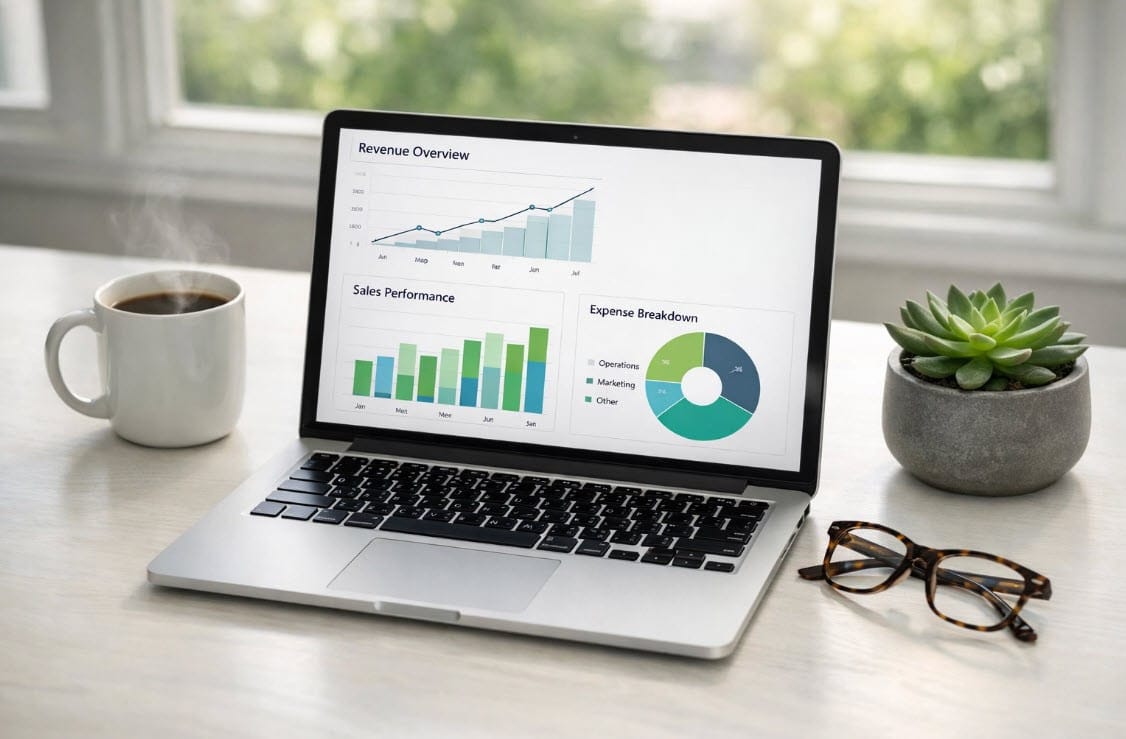
Why Intuition Isn’t Enough for Evidence-Based Strategy
We often hear that “entrepreneurs are risk-takers.” While that’s true, the most successful entrepreneurs aren’t gamblers: they are strategists.
In a volatile market, your intuition can be clouded by stress, excitement, or even what your competitors are doing. Clear financial data acts as a grounded anchor. It allows you to respond to market changes based on empirical evidence. For example:
- Identifying Revenue Trends: Is your sales growth steady, or is it just a seasonal spike? You can’t tell by looking at one month of invoices. You need to see the trend over time to know if it’s time to scale up.
- Spotting Hidden Risks: A supplier might offer a “discount” for bulk buying, but if your numbers show that your cash flow is currently tight due to slow-paying clients, that “deal” could actually cripple your ability to pay rent next month.
- Pricing Strategy: Are you actually making money on every job? Many business owners realize: too late: that their most “popular” service is actually their least profitable because they haven’t accounted for the rising cost of labor or materials.
To truly grow, you must understand your break-even point. Knowing exactly how much you need to make just to keep the lights on changes how you view every new lead that comes through the door.
Three Growth Decisions You Can’t Make Without Data
If you are looking to move your business from a “side hustle” mentality to a scalable company, there are three specific areas where “winging it” will cost you the most.
1. The Decision to Hire
Hiring is the biggest expense and the biggest risk for a small business. Clear numbers tell you more than just “can I afford the salary?” They tell you the Return on Investment (ROI) of that person. If you hire an assistant for $4,000 a month, how many hours does that free up for you to do $500-an-hour work? If the data shows you’ll gain 20 hours of high-level work time, the decision becomes an easy “yes.”
2. The Decision to Pivot
Sometimes, a part of your business isn’t working. Maybe a specific product line is dragging you down. Without clear reports, it’s hard to let go of something you’ve put heart and soul into. But when the numbers show that a specific service has a 5% profit margin while another has a 40% margin, the emotional weight of the decision lifts. The data makes the choice for you.
3. The Decision to Invest in Marketing
Marketing is often the first thing cut when things feel tight, and the first thing funded when things feel flush. Both are often mistakes. By monitoring key performance indicators, you can see exactly what your customer acquisition cost is. If you know that every $1 spent on ads brings in $5 in profit, you don’t “feel” like you’re spending money: you know you’re buying growth.

The Mental Load: Why Clarity Equals Calm
Let’s be honest: the reason many business owners avoid their numbers isn’t that they are “bad at math.” It’s that they are afraid of what they might find. There is a specific kind of anxiety that comes from the “Financial Fog”: that hazy space where you aren’t quite sure if you’re winning or losing.
You’re not alone in feeling this way. But here is the eye-opening truth: The reality is almost never as scary as the “not knowing.”
When your books are clean and your numbers are clear, that tightness in your chest starts to dissipate. Even if the numbers show you have a problem, you now have a problem you can solve. You can’t fix a “feeling” of being broke, but you can fix a high overhead cost or a low-profit margin once you see it on paper.
Clean bookkeeping gives you more than just a tax return; it gives you your nights and weekends back. It gives you the ability to sit at the dinner table without mentally calculating if the check you mailed today will bounce.
A Competitive Advantage You Can Actually Use
In the modern business world, data is a core strategic asset. Large corporations have entire departments dedicated to financial analysis. As a small business owner, you don’t need a whole department, but you do need the same level of clarity.
Businesses that collect and analyze their financial data have a massive competitive advantage. While your competitors are guessing, reacting to the news, and panicking during slow months, you are moving steadily. You are making evidence-based decisions that align with your long-term goals.
This capability is what separates a business that provides you with a job from a business that provides you with a scalable asset.
One Small Step Toward Clarity
If your numbers feel like a giant, tangled ball of yarn right now, don’t feel like you have to untangle it all today. The path to clear decision-making doesn’t start with a complex 5-year forecast. It starts with one small step.
Take ten minutes today to look at just one thing: Your Gross Profit Margin.
Do you know, to the penny, what it costs you to deliver your service or product before you pay for overhead? If you don’t, that’s your starting line.
You don’t have to be a “numbers person” to have a successful, data-driven business. You just need a system that brings the truth to the surface so you can do what you do best: lead.
If you’re tired of the “Maybe” method and you’re ready to see what’s really going on under the hood of your business, we’re here to help. Let’s clear the fog together.
Ready to stop guessing? Book a free consultation today and let’s talk about how clean books can become your secret weapon for growth.



0 Comments