
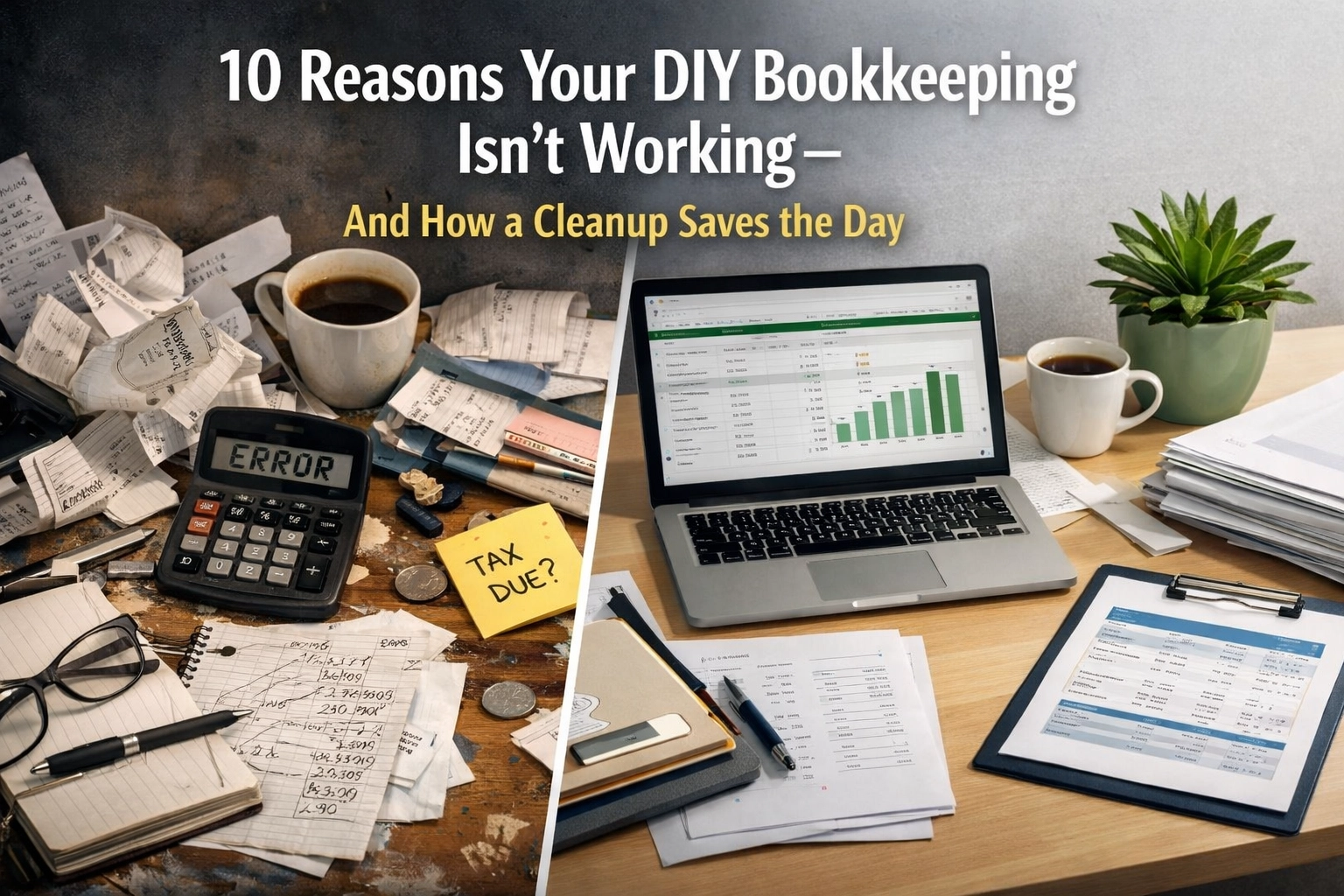

Real talk: You started your business because you have a passion for what you do. Whether you’re a creative designer, a dedicated consultant, or a local service pro, you’re an expert in your field. But unless your field is accounting, you probably didn’t start a business because you were dying to spend your Friday nights staring at a spreadsheet and a mountain of receipts.
If you’ve been trying to handle your own books, you might feel like you’re doing “okay.” But then tax season rolls around, or you try to apply for a loan, and suddenly that “okay” feels like a giant, tangled knot of numbers. You aren’t alone: a recent QuickBooks survey found that a staggering 60% of small business owners don’t reconcile their books monthly. That’s like trying to drive a car with a blindfold on; you might be moving, but you have no idea where you’re headed or how much gas is left in the tank.
The truth is, DIY bookkeeping often hits a wall. When it does, it doesn’t just cause stress: it costs you real money. Here are 10 reasons your DIY bookkeeping might be failing you, and how a professional cleanup is the secret sauce to getting back on track.
The 10 Common Pitfalls of DIY Bookkeeping
1. The “I’ll Do It This Weekend” Trap
We’ve all been there. You’re busy running the show, and bookkeeping feels like a “later” task. But “later” turns into next month, which turns into next quarter. Procrastination is the number one reason books get messy. When you’re rushing to catch up on six months of data in one night, mistakes aren’t just likely: they’re guaranteed.
2. The Mystery of the Missing Reconciliation
Reconciliation is just a fancy word for making sure your bank statement matches your bookkeeping software. If you aren’t doing this every single month, your business checking balance is probably wrong. Without regular reconciliation, you risk missing bank errors, duplicate charges, or even fraudulent activity until it’s far too late.
3. “Double Trouble” (Duplicate Transactions)
This is a classic DIY headache. Maybe you recorded a credit card payment manually, and then your bank feed imported it again. Now it looks like you spent twice as much as you actually did. These duplicates distort your profit margins and make your business look less healthy than it actually is.

4. The “Miscellaneous” Abyss
When you aren’t sure where an expense goes, it’s tempting to just dump it into “Office Expense” or “Miscellaneous.” But if half of your spending is in a category that tells you nothing, you’re losing out on financial clarity. You can’t cut costs if you don’t actually know what you’re spending money on.
5. Receipt Amnesia
“I’ll remember what this $45.12 charge at Target was for,” you tell yourself in July. Fast forward to January, and you have no idea if that was for printer ink or a new coffee maker for the breakroom. Poor record-keeping makes you an easy target for the IRS and means you might be missing out on legitimate tax deductions because you can’t prove the business purpose.
6. Creative Accounting (The Non-Standard Chart of Accounts)
If your Chart of Accounts: the list of categories where you track income and expenses: looks more like a grocery list than a financial document, your CPA is going to have a hard time at tax season. Using an idiosyncratic or overly complex setup usually leads to a massive bill from your tax pro just to “fix” the categories before they can even file.
7. The Cash vs. Accrual Identity Crisis
Do you record income when you send the invoice or when the check clears? Many DIY-ers get these two methods mixed up. Most small businesses use cash-basis accounting, but software often defaults to accrual. If you’re accidentally mixing the two, your reports are going to be a mess, and your tax ready financials won’t be as ready as you think.
8. Leaving “Real Gold” on the Table (Missed Deductions)
Professional bookkeepers help you stay organized and consistent all year, and they’re familiar with common business expenses that often turn into deductions. When you DIY, it’s easy to miss the “secret sauce” details: things like home office percentages, mileage, or properly tracking industry-specific costs: which makes it harder for your tax professional to spot every deduction you may qualify for. Every missed deduction is money straight out of your pocket.
9. Software Overload
Just because you have a subscription to QuickBooks or Xero doesn’t mean the books are “doing themselves.” Automated bank feeds are great, but they are only as good as the person clicking the buttons. Without the proper setup, automation can actually create a bigger mess, faster.
10. Flying Blind on A/R and A/P
Do you know exactly who owes you money right now? And do you know exactly how much you owe your vendors? When DIY bookkeeping falls behind, your Accounts Receivable (A/R) and Accounts Payable (A/P) are the first things to get fuzzy. This leads to cash flow surprises that can stall your growth.

How a Cleanup Saves the Day (And Your Sanity)
If the list above made your heart race a little, take a deep breath. This is exactly why bookkeeping cleanup services exist. Think of it like a deep spring cleaning for your house. You might be able to handle the daily dusting, but sometimes you need a pro to come in, scrub the baseboards, and organize the closets so you can actually function again.
When we handle a cleanup at Silvera Financial, LLC, we don’t just “fix” numbers: we give you a fresh start. Here is how a cleanup transforms your business:
- We identify and correct errors: We hunt down those double entries and misclassified transactions that are skewing your data.
- We streamline your Chart of Accounts: We make your books lean and standard, which makes your CPA happy (and usually lowers your tax prep bill!).
- We reconcile everything: We go back through the months (or years!) to ensure every penny is accounted for.
- We get you “Tax Ready”: No more scrambling in April. Your financials will be organized, accurate, and ready to hand over to your tax professional.
The Bottom Line: Clarity is Power
Imagine waking up on the first of the month and knowing exactly how much profit you made. Imagine looking at a report and seeing exactly where your money is going: and where you can afford to invest more. That is the power of professional bookkeeping.
A cleanup isn’t just about looking backward; it’s about setting the foundation for the future. Once your books are clean, monthly bookkeeping becomes a breeze, and you can finally focus on the “big picture” of growing your business.

Ready for a Clean Slate?
Don’t let messy books hold your business back any longer. Whether you need a one-time bookkeeping catch up or you’re ready to hand off the reigns to a pro, I’m here to help.
Let’s get those books off your plate! Click here to book a free consultation on my Calendly and we’ll chat about how to get your business back in the black.



0 Comments